Books
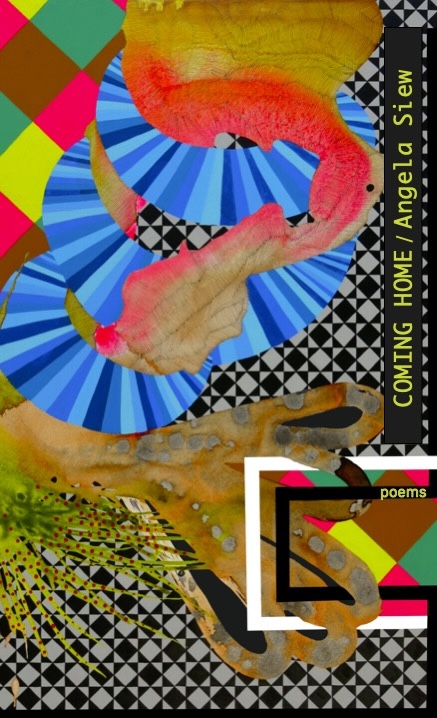
2024 CutBank Chapbook Contest Runner-Up
(University of Montana)
Scroll down and click on “Full Inventory,” then scroll down to “Chapbooks” to find the link to order Coming Home.
Please contact me if you’d like to purchase a personalized copy.
Cover Image: The Past Is A Memory, The Future Is A Fantasy, by Kim Carlino
Angela Siew’s poems are both economical and rich, gentle and urgent. She captures the deep love among generations and her place in their tradition. As family members age and confront mortality, the speaker of these poems deals with her uneasy position as conduit between the long past and the immediate present. Coming Home is a powerful and moving collection.
-John Skoyles, Ploughshares Poetry Editor & Author of Suddenly It’s Evening: Selected Poems
“In the silence before sound enters the air,” Angela Siew reflects, “I feel as if I’m about to shatter.” The flawlessly composed poems of Coming Home might be said to have a similar effect upon the reader, where every line’s gesture, every image—like the deftest brush stroke—marks an edge where sound and silence join harmonically and movingly together. Like the artist to whom she pays homage in another poem, or her father’s intricate attentions at his own craft of making, Siew is a poet of quiet discoveries that resonate tenderly and profoundly in their ties to loved ones and the world; discoveries that overbrim and amplify long after each poem has ended.
-Daniel Tobin, Author of The Mansions
Angela Siew’s Coming Home brings us to the intersections of what is remembered and what is fading. Whether noodles with the mother, a father’s playing a guitar minuet, or writing Chinese, what is rendered is rendered in tenderness that compounds as we move through the poems into familial intimacies. In these poems the speaker prays to the deity, yes, but more deeply to those people who made her a person, asking “Dear God, Am I / your creation, / or a reflection of you?” Siew’s voice as a poet is one to listen to carefully, to warm your hands against, to let enter your temple, to let instruct you on all the forms of supplication.
-Rajiv Mohabir, Author of Whale Aria
The Gift
My nephew doesn’t know the strokes of his Chinese name.
He doesn’t know the beginning characters
like person, the first part falling from left to right
forming the torso and leg, the second finishing
the body. He doesn’t imagine the tiny marks
on either side as hands holding flames to make fire,
the hooks on moon as points of a slender crescent.
It is not his mother tongue, only the tongue
of his grandparents. To him, a box
doesn’t create the contours of country,
eight lucky strokes and a mouth neatly packed inside.
It is not my first tongue either.
I forget, sometimes, that mouth is in our surname,
that my brother and I share a mountain peak.
I am woman, and he is man. Together
we make the word for good.
My father is a poet in his first language.
I give my nephew the Boggle Junior from my childhood,
the cards with simple illustrations,
words spelled out three or four letters across.
Box! B-O-X! When my father asks him
what a box is, he says,
It’s something you use
to carry something else inside it.
(First published in Dialogist)

PDF available to borrow through Biblioboard
 Poet | Instructor